Monday, 22 July 2013

Wear Valley Writers Go Walking.

On the last Sunday in June some of the Wear Valley Writers met at Harehope Quarry near Frosterley for a literary walk that would offer inspiration for our writing. We were led by one of our own group. 
(See  below.)
On Sunday July 28  at 2pm, another of our members will lead us round Vinovium, the Roman site on the outskirts of Bishop Auckland. He is a volunteer there and very knowledgeable about the site, so we look forward to an informative afternoon.
If you are a writer and interested in this idea you are welcome to join us.


The following report recorded my impressions of the day.


A tangled mass of leaves - every shade and every shape - hide the gurgling stream that is Bollihope Burn so very far below.  The narrow river, brown as the earth, ripples peacefully between ancient stones for all the world as though it wasn’t hidden deep, deep down below the level of the path.
There is no sound from the nearby caravan park and the sun is behind a cloud. We are in a separate world where green hills surround us with remote farmhouses dotting their sides, stone-built and strong against the Weardale weather.
And so we start to walk, glad of our collars to pull up against the cold wind – uphill at first on an easy tarmac path then turning to a narrow track.  Wild flowers are everywhere; pink and white Clover; Vetch; Ladies Fingers; Marguerites and grasses; Thistles and Star of Bethlehem. May blossom is in the hedges with the gentle hum of bees all round it.  Silent sheep move in one field and brown and white cattle graze in another.
But it all changes as we clamber down uneven steps to a gorge and a dry-stone riverbed where the burn flows underneath the surface, appearing only in the harshest of winters.  It is the result of weathering of the limestone. There are potholes and caves and resurgent streams – Karst scenery an information board explains.
As if to compensate for this harshness a square block of Frosterley Marble sits beyond the bridge, its fossil-rich limestone is 310 million years old.  Sprinkle water on to it and see the mass of fish and strange creatures that are trapped inside.
From there we walk on to the viewing post and look out at the Quarry where men toiled their lives away in all weathers.  We see the twenty layers of Rock they worked on, each one named; The Yard Post; the Whalley; Thick Cockle Beds; Thin Cockle Beds; Elsie; Dun Kits Bastard and so on. Nowadays there is peace and silence and we gaze out at the burn, framed by green trees and flowing to the distant hills.
As we clamber back to the footpath the breeze is lighter, the path downhill and the sun is warming the stone of the farmhouses high on the distant hills.


Monday, 8 July 2013

King's Cross Station


 King’s Cross station has been modernised.  It is awe-inspiring and splendid.  It has a spectacular roof structure; shops and cafes on two levels with an elaborate balcony where people can look down on to the melee below. There’s a taxi rank that is fast and efficient and an Underground station that will be shared with St. Pancras station when it is finally completed.
This Way to the Underground Station

But I feel so nostalgic for the old King’s Cross. Even when I was a little girl I looked forward to the thrill of arriving in that dark, cavernous station where engines hissed and snarled and crowds queued to board the trains for the long journey back to Newcastle and Edinburgh and Aberdeen.  There used to be a flower-stall – a bright splash of colour and a perfume to remind you of the country. A few steps further and you were in the area edged by shops with W.H.Smith always open and food stalls with their variety of sandwiches and drinks or exotic soups in cardboard containers to take onto the train with you.  There were wooden seats – never enough, but with luck you might find one while you stared at the old Departure Board to discover which platform your train would leave from.  It was never far away.  Even the toilets were accessible if not always hygienic. They were not in the remotest corner as they are now, forcing passengers to drag heavy luggage; dodge people’s feet and avoid the crowds; even skirting a queue of people waiting to be photographed by a blank wall marked Platform Nine and Three-quarters.The striped scarf passed from one to another evidently making it more authentic.
I’ve no doubt the old station provided a haven for the homeless and undesirables – the new one is locked as soon as the last train leaves.

Across the road St Pancras station is also huge and modern and wonderful, but it somehow creates a more friendly atmosphere.  I had to laugh at the sight of an upright piano standing between the shops and marked   PLAY ME. I’M YOURS.
I hoped somebody would accept the invitation, but nobody did.  They were all too involved in their own plans for the day ahead.

Friday, 14 June 2013

Widecombe Fair.

Tom Pearce, Tom Pearce, lend me your grey mare
All along, down along, out along lee.
For I want to go down to Widecombe Fair
Wi’ Bill Brewer, Jan Stewer, Peter Gurney,          
Peter Davy, Dan’l Whiddon, Harry Hawk,
Old Uncle Tom Cobley and all                                                   
Old Uncle Tom Cobley and all.

As a child I sang this song with gusto but never stopped to think about the words or wonder whether there was any truth behind its story. So it came as a surprise to find myself in the tiny village of Widecombe last week on one of the hottest days of the year.
Staying in Devon, I joined a coach tour across Dartmoor.  The views were stunning; ponies everywhere, their foals a delight to see. After stopping to climb High Tor and look down on other counties spread out below, we scrambled  back into the coach and descended the steepest of hills into a picturesque village – Widecombe.

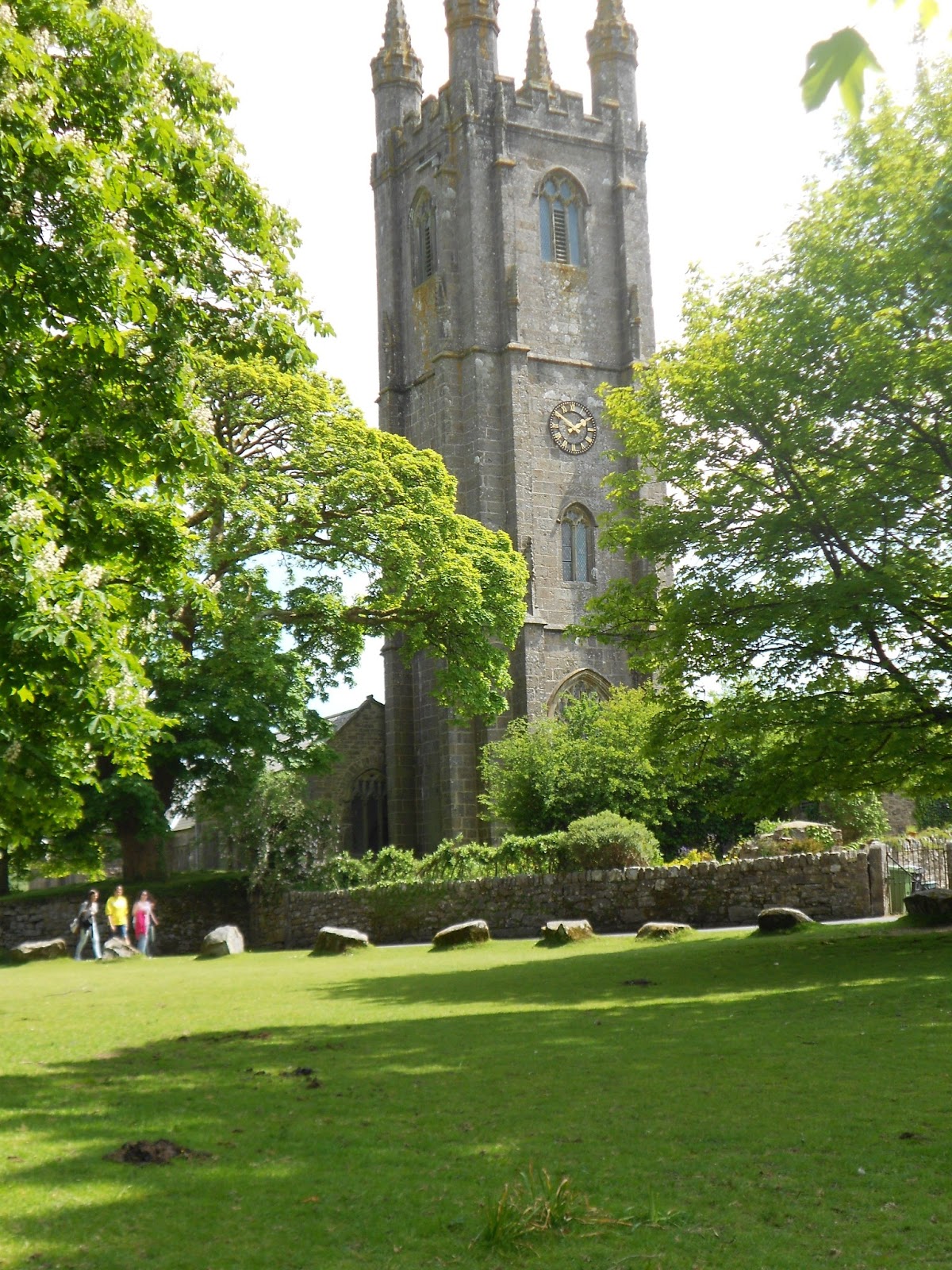
A wide green, under a glorious copper Beech tree; stone cottages; quaint tea shops and tiny general stores. All in the care of the National Trust, it is the epitome of an English village.
The Cathedral-in-the-Moor
To one side of the green is the church of St Pancras with its solid square tower reaching towards the hills.  It's known as the Cathedral-in-the-Moor.
Walk inside and discover a large model of the Old Grey Mare; Uncle Tom Cobley and All, made by the late Harry Price and exhibited by the Widecombe History Group.
And on a board on the Green the 2013 Fair is advertised – after all these years it still goes on.

Friday, 31 May 2013

Strange Tastes

Have you ever sat in a café and glanced at the people round you?
It’s fascinating to see the things they eat and the way they behave;
so different from your own ways.

The elegant café at Bowes Museum a few days ago was so busy, that as I sat
with a friend I couldn’t help but watch my neighbours. I was amused to see that one little boy had toasted teacake and chips, while a small girl at another table ate strawberries with her sandwiches.

I wonder if these were simply childish trends or a new variation on the menu!


Monday, 13 May 2013

Shar Pei Dogs and Photography


Have you ever tried to get a professional photograph of a Shar Pei dog?

Believe me, it’s not easy and I speak from experience. After thinking I’d come up with the perfect birthday present for a man who has everything, I booked an appointment with a skilled young photographer in Barnard Castle.
As Shar Pei’s go, the dog behaved well but then they’re not known for their easy manner and quick response – they don’t leap after sticks and their ears are too small to prick up at the sound of a squeaky ball - which is obviously necessary for natural-looking photograhs.
For the first ten minutes Winston moved obediently from side to side, graciously accepting nibbles of cooked chicken and looking reasonably amenable.  After that, he lost interest and the poor photographer had to move from one position to another, even lying on her back to get better poses of him! 
By the end of the session I thought she might have a nervous breakdown and I did my best to reassure her that some of the pictures were certain to represent the Shar Pei breed; that is haughty and aloof.
It was probably a ridiculous idea of mine and next year I’ll buy Chocolates and After-Shave as usual, but I must say I await the results with interest.

Sunday, 28 April 2013

Keswick in Springtime.

Memorial to John Ruskin 1900


A Saturday in April and the sun shone as it’s supposed to do in springtime. 
Keswick was its usual bustling self, although a strong wind still whipped around the lake making boats bob like corks. However, it was a perfect day for a short walk to Friar’s Crag, a promontory jutting into Derwentwater and described by Ruskin as one of the three most beautiful scenes in Europe.
From Friar's Crag


We almost resented the time we spent in the Theatre by the Lake, watching “Rogue Herries,” Walpole’s play set in Borrowdale at a time when men could sell their womenfolk  in the Keswick market. The large cast of professional and amateur actors portrayed the story well.                                                 

Looking Back Beyond Keswick.

In the interval we wandered out into the sunshine again and were brought back to the present day by the sight of a Rescue helicopter taking off from the grass immediately opposite the theatre doors. 

The Rescue Helicopter

Tuesday, 16 April 2013

A Coincidence.

On Sunday the weather was damp and dismal, but it didn't detract from the pleasure of visiting a spring garden around a solid town house in Bishop Auckland.  This was opened under the National Gardens Scheme.
Mauve and white crocuses filled one very big corner.  Bird boxes hung from every tree; Northumbrian pipers played gentle music from the summer house and water poured from the four faces of a fountain.
But the most interesting thing was my conversation  - over tea and cake - with the present owner, who said the house was built in 1856 by a prominent Bishop Auckland family and had changed hands only twice since then.  She was both surprised and delighted when I added that I owned a grandfather clock that had belonged to that first family.
It is very plain; possibly a kitchen clock and certainly not valuable any more, but I would never part with it.
When the first family came to an end, their furniture was auctioned; my mother went to the sale and she bought the clock for my first home.  It's been with me ever since.
So - a very special Sunday afternoon!